
Searching for a Warrant in Long County
Begin with the Long County Sheriff’s Office. Call 912-545-2118 first. Georgia guidance lets sheriffs take warrant questions by phone or in person, and the office may ask for a full name, date of birth, or identification. Walk in only after calling, because a confirmed active warrant at the counter can end in custody. Talking with counsel before an in-person inquiry is a wise step in Long County.
- Prepare the full legal name and date of birth.
- Call LCSO before visiting its Ludowici office.
- Ask which court issued the warrant and what status LCSO can confirm.
- Contact that court for docket, recall, and appearance information.
- Request existing sheriff records in writing when verbal confirmation is not enough.
Long County runs four separate dockets. Ludowici Municipal Court takes city citations, while Magistrate Court handles warrant applications and preliminary matters. State Court covers misdemeanors and traffic. Felonies belong to Superior Court.
No Public Long County Full Search
Long County posts no full name-search form anywhere. The sheriff’s public warrant page describes internal processing only. The Most Wanted list is curated, and Georgia’s own warrant page simply points back to the local sheriff. Treat these as firm limits on any warrant search, not gaps in your method.
Key Point: A blank or unavailable roster is not proof that no warrant exists. Ask the sheriff and issuing court for current status.
Skip paid databases as a shortcut. They can copy stale data, miss a recall, and blur a charge, a case, and a warrant into one misleading entry. Only Long County officials hold the current answer.
Warrant Search Fields Explained
Long County publishes no public warrant form to fill in. Georgia guidance lists what a sheriff may ask for, so have those details ready. Full name and date of birth are the usual starting points. Give only what the office requests.
| Field | Use | Limit |
|---|---|---|
| Full name | Starts identity matching | Similar names require more detail |
| Date of birth | Separates people with the same name | Send through the channel LCSO approves |
| Case or citation | Helps the court locate its file | May be unknown before the first call |
| Issuing court | Routes recall and docket questions | The sheriff may need to identify it |
| Missed date | Helps with FTA inquiries | Does not prove a warrant issued |
A completed criminal-history form is not a warrant lookup. LCSO in Long County treats the two as separate services.
Phone First for Long County Warrants
Calling first works best here, because the public database is closed. It also saves a wasted trip. LCSO sits at 6 East Academy Street, Ludowici, GA 31316, with mail to P.O. Box 368. Posted administrative hours run 8:00 a.m. to 5:00 p.m. daily. Confirm current access and the right staff member before you drive. The sheriff contact form is not an emergency channel, and the sheriff’s contact page itself warns against sending sensitive information through it.
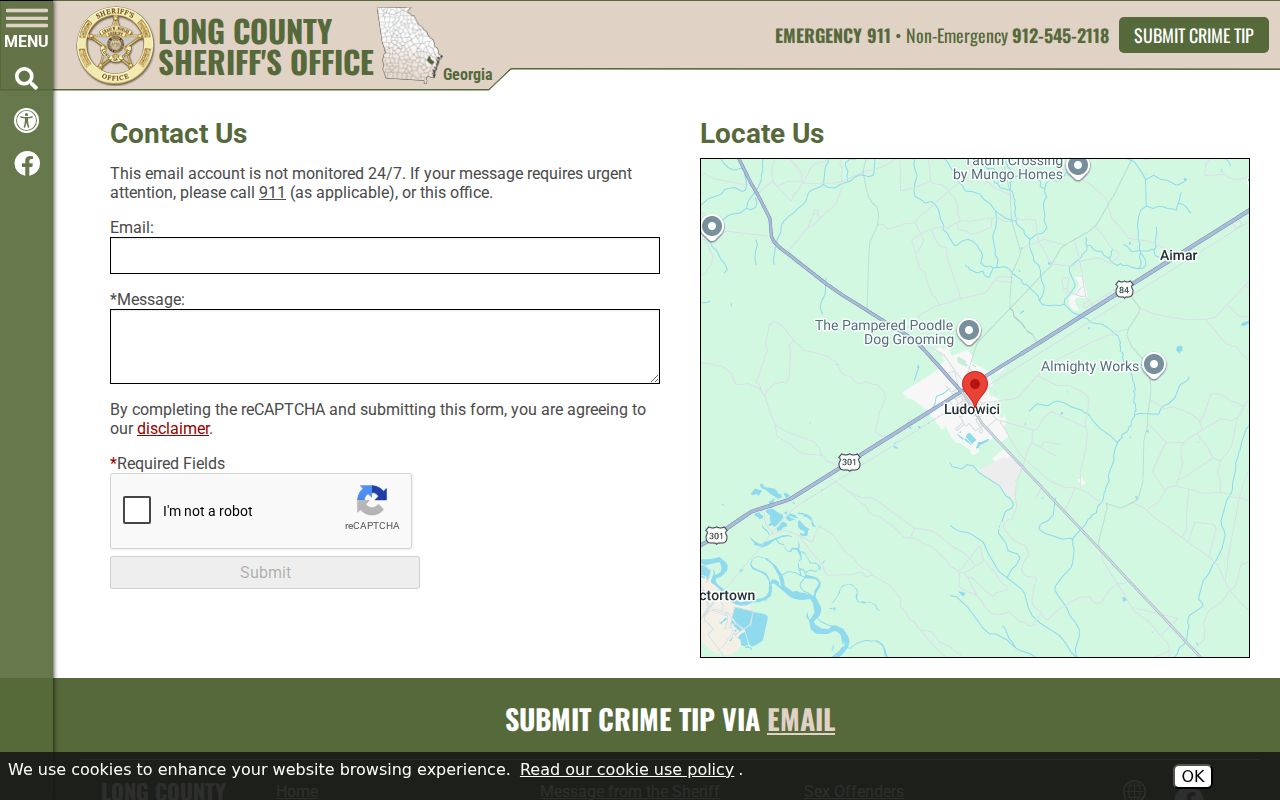
The form can carry a basic message. Do not put sensitive identifiers in an ordinary web message unless Long County staff asks for them.
What a Warrant Search Shows
A current Long County answer may show the warrant, the issuing court, the allegation, its status, and bond details. How much is public depends on the record and its exemptions.
| Identifier | An official warrant, case, incident, or citation number, if available. |
|---|---|
| Issuing court | The court that controls the order, appearance, and recall. |
| Charge | The stated allegation, not a finding of guilt. |
| Issue date | When judicial process began, not when a web item was posted. |
| Status | Active, served, returned, recalled, released, quashed, or unconfirmed. |
| Bond | Terms set by the proper judicial body, not LCSO. |
Long County posts no sample warrant number format, so copy any identifier exactly as the current record shows it.
Long County Court or Sheriff
Match the question to the office. LCSO can explain receipt, service, internal status, surrender, and its own records. The court answers for its order, docket, court date, and recall. Neither answer replaces the other in Long County.
| Question | Office |
|---|---|
| Is LCSO holding an executable warrant? | Long County Sheriff’s Office |
| Was a warrant recalled or quashed? | Issuing court clerk |
| Was a city traffic date missed? | Ludowici Municipal Court |
| Is there a misdemeanor or traffic case? | Long State Court |
| Is there a felony docket? | Long Superior Court |
State and Superior Court share a clerk at 912-545-2123. Magistrate Court sources split between 912-545-2315 and 912-545-2131, so verify the live Long County number.
Long County Magistrate Warrant Role
Magistrate Court in Long County handles warrant applications, arrest and search warrants, preliminary hearings, and bail where no other court holds that power. LCSO describes a route that starts with an incident report. From there it may move to a scheduled hearing and a judicial decision. There is no online public warrant application. The official Magistrate Court page carries the local warrant, preliminary-hearing, and bail language.
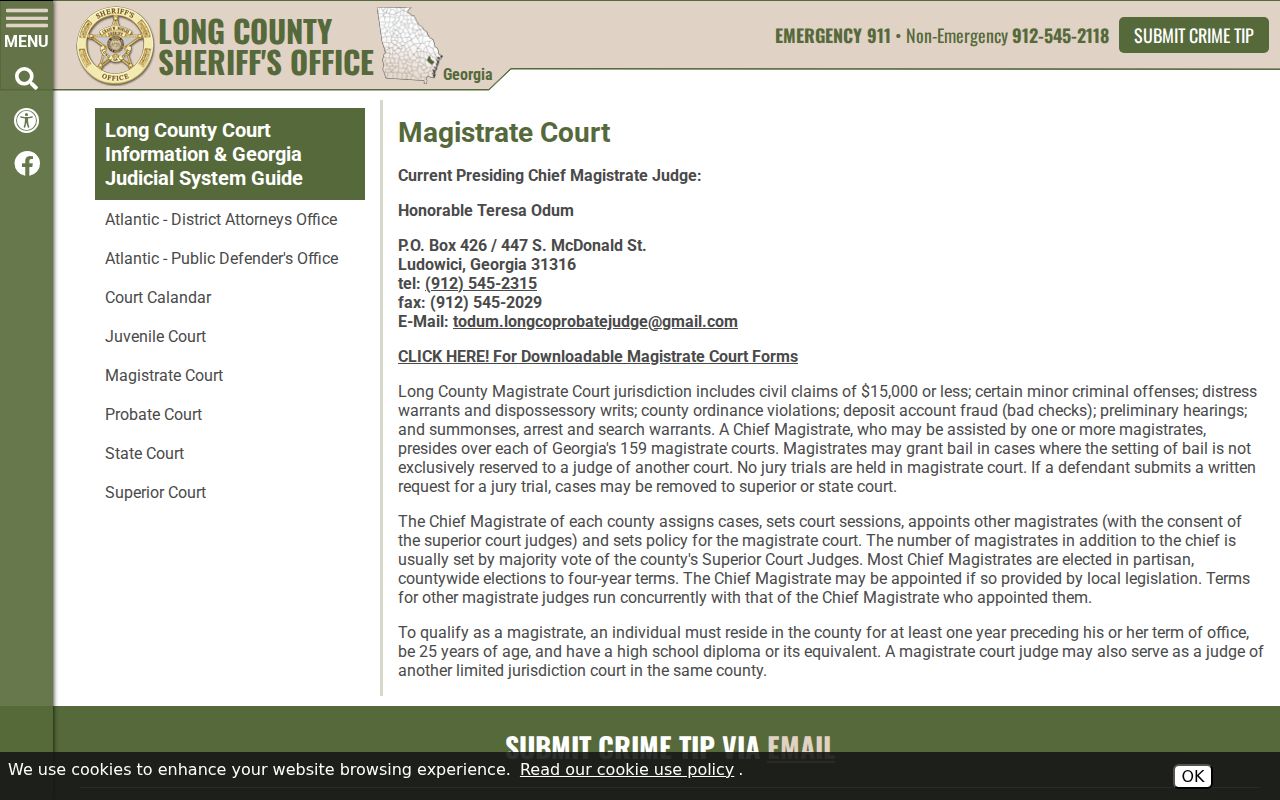
The court source settles who has authority. For execution status, the Long County sheriff remains the practical place to ask.
Where to Check Warrants in Long County
No single screen ties every Long County court and agency together. LCSO processes criminal arrest warrants. Magistrate, State, Superior, and Ludowici Municipal Court each keep records within their own jurisdiction. Georgia Courts e-access may surface Long State or Superior case information after an account-provider handoff. It is not a warrant index. GCIC and NCIC exist for law enforcement only, with no public name search. DDS handles a separate traffic FTA license consequence, not the recall of a court warrant. A federal matter in the Southern District of Georgia belongs with federal court, PACER, or the U.S. Marshals Service. Knowing which Long County office holds the record is half the search.
Note: Ask which office owns the exact record component instead of sending the same broad request to every Long County office.
Open Records for Long County Warrants
The LCSO Open Records page lists records@longcountyso.org and commits the office to a response within three business days when practicable. Ask for existing disclosable records, not a new status report. Include a date range and any known case or incident identifier. Request issue, service, return, recall, or release records if those are what you need. Fees can cover search, retrieval, redaction, and production, though the first fifteen minutes carry no charge. The separate $20 criminal-history service is not a warrant fee. If LCSO does not hold the court document, ask it to name the likely custodian. The sheriff also runs a crime-tip form, but that is not a records-request or warrant-check channel. Its controls sit on the official tip-form page itself.
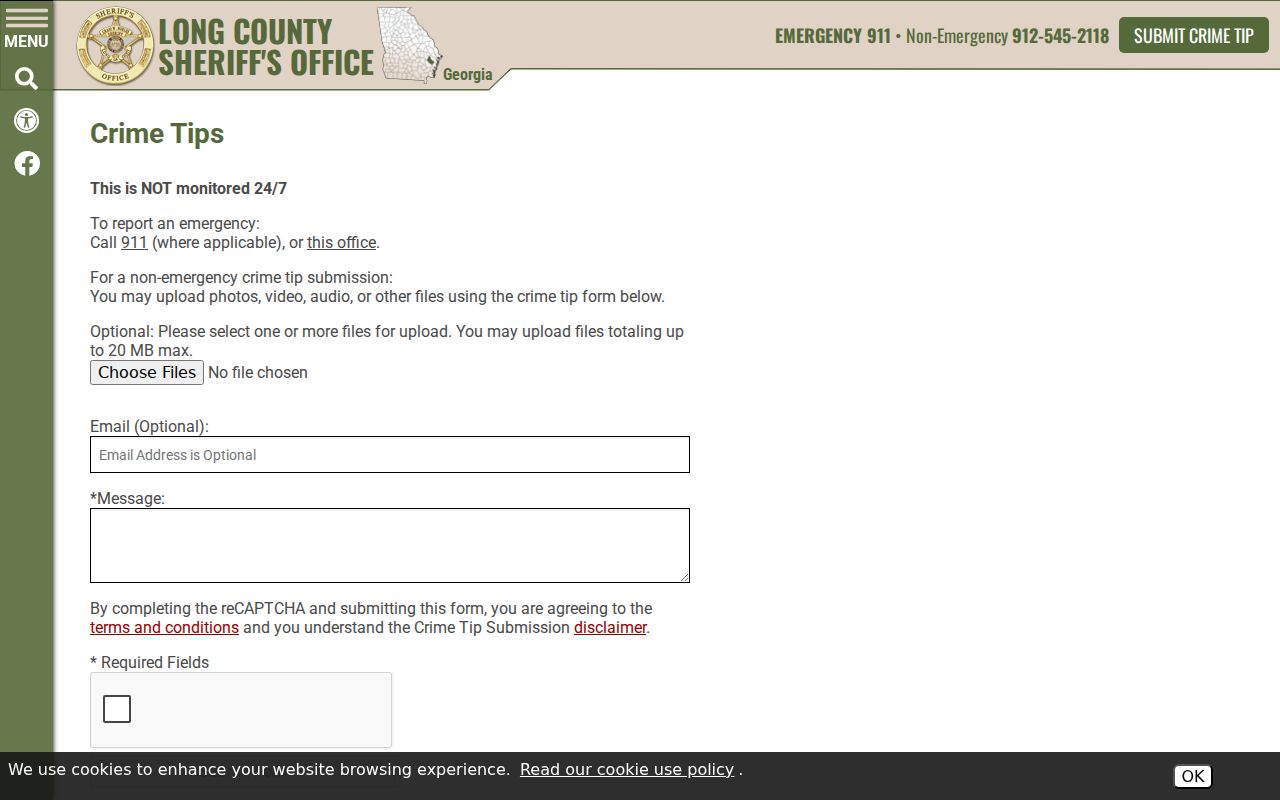
Use the records email for record requests in Long County. Save the tip form for its stated public-safety purpose.
Restricted Warrants and Access Rules
Georgia’s Open Records Act stops short of opening every file. In Long County, agencies may redact or withhold pending-investigation material, juvenile information, medical data, protected-person details, confidential sources, and investigative methods. Search-warrant affidavits draw extra caution while an investigation is still active.
Access rule: Ask the custodian to cite the specific exemption for any withheld or redacted Long County record and to release the rest when allowed.
An agency in Long County does not have to build a new compilation on request, under O.C.G.A. § 50-18-70. Response and cost rules sit in § 50-18-71. Exemptions are listed in § 50-18-72. A denial, though, is not proof that no warrant exists.
Keep the responder’s name, date, and source for your own file. When a written recall or release proof exists, request it. Then confirm the court and sheriff records both reflect it.
If a pending investigation blocks access, ask whether an initial incident or arrest report can come out now, and when the withheld material gets another look. Juvenile records go through the Juvenile Court clerk, not the adult Most Wanted format. A narrow request in Long County can keep useful public fields open while protected facts stay redacted.