
Checking for a Warrant in Long County
Start with the Long County Sheriff's Office Warrants Division, the first public contact for a possible arrest warrant. Its page explains processing and service but does not open the office database to the public, and Georgia's own guidance points people to the local sheriff. Call 912-545-2118 before you drive over if you can. Keep a full legal name and date of birth handy. Ask whether status can be confirmed by phone, whether you must show identification, and which court issued the warrant. One call rarely finishes a full Long County warrant check, because custody of the paper is split. The sheriff holds execution records, while the issuing court keeps the application, order, docket, and any recall. Ludowici Municipal Court takes city citations and ordinance matters, Long State Court handles misdemeanors and traffic cases, and Superior Court is the felony and general-jurisdiction court.
- Call the Long County Sheriff’s Office and ask for its warrant inquiry procedure.
- Give only the identifying details the office requests.
- Contact the issuing court for its case record and current court status.
- Use a written Open Records request for existing, disclosable sheriff documents.
- If a warrant is confirmed, speak with a lawyer before surrender, bond, or a court filing.
Long County Has No Full Warrant Portal
Long County publishes no full warrant portal for the public. The sheriff's site does carry a Most Wanted interface, but that page is a curated publication, and it can display "Content unavailable at this time" rather than a roster. Treat it as a public list, not a mirror of the internal warrant database. Even a blank result proves nothing about whether a Long County warrant exists. When content loads, the official Most Wanted interface offers controls for name, posting date, and arrested status. Those filters describe a published roster only. They do not reach every entry held in GCIC, NCIC, the sheriff's database, or the court files, so the page is a starting point rather than a complete warrant lookup.
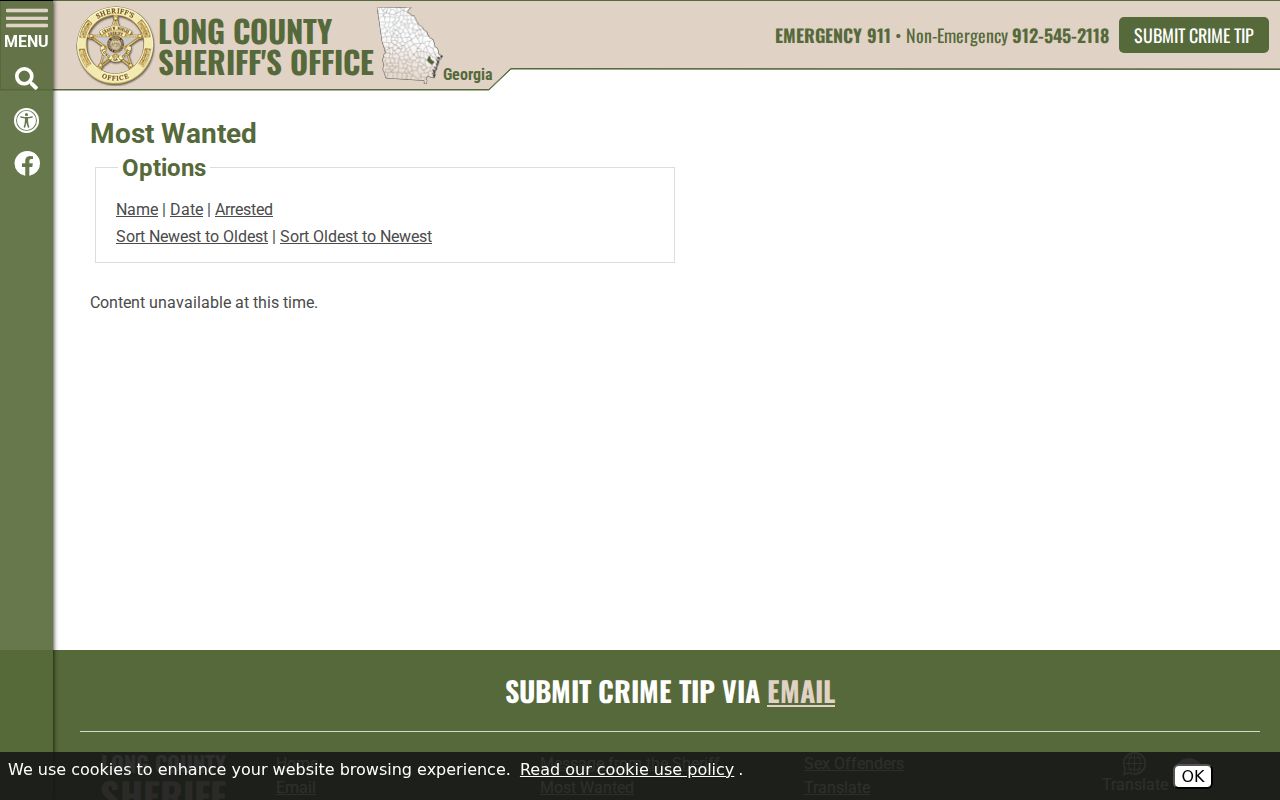
The empty interface reinforces the need to confirm status with a custodian.
Long County Warrant Types
Long County courts use different processes for different cases, and "warrant" is not one uniform record. Where you should inquire depends on the court, the reason for issuance, and the current status. A search warrant permits a search and should never be confused with an arrest command.
| Warrant Type | How It Arises | Issuing Authority |
|---|---|---|
| Arrest warrant | A judge authorizes custody in a criminal process. | Magistrate, State, or Superior Court |
| Bench warrant | A court directs custody in an existing case, often after nonappearance. | The court handling the case |
| Search warrant | A judge authorizes a search based on the required showing. | An authorized court |
| Capias or FTA | A missed appearance or failure to respond triggers court action. | State or Municipal Court, based on the case |
In Long County, FTA means failure to appear, while a capias is a court-directed custody process. The labels overlap but are not always interchangeable. Ask the clerk which term governs the case.
Long County Sheriff Warrant Workflow
The official warrant page explains what happens behind the counter at the Long County Sheriff's Office. Once a criminal arrest warrant reaches LCSO, staff process it, enter it in the sheriff's computer database, identify the subject, and handle the GCIC and NCIC steps. A local address may go to the Uniform Patrol supervisor for attempted service. The division also works leads and sends warrants to other agencies.
The documented flow is court issues warrant → sheriff processes entry → GCIC/NCIC handling → patrol or another agency attempts service → booking and bond steps → court notice. GCIC and NCIC are restricted systems, not public websites.
The sheriff’s description is shown in the official source capture.
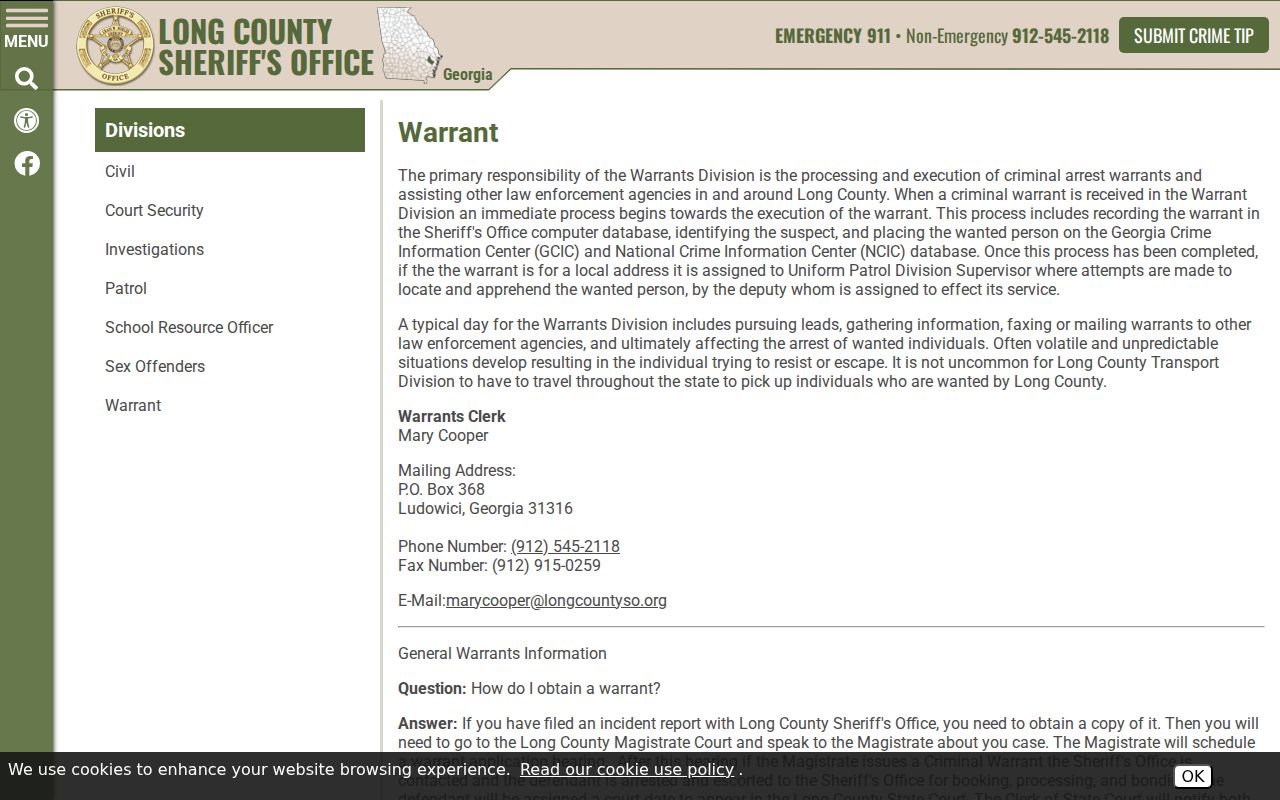
The image documents office workflow and contact information, not a public roster.
Inside a Long County Warrant Record
Long County publishes no sample warrant and no complete number pattern. Ask instead for fields tied to a known name, court, incident, case, or citation. The useful parts may sit split between sheriff and court files.
| Warrant or case number | Copy the official identifier exactly when disclosed. |
|---|---|
| Subject | Name and identifiers used to separate similar names. |
| Charge | The stated allegation, which is not a conviction. |
| Issuing court | The court with authority over the order and recall. |
| Bond | An amount or condition set by the proper judicial body. |
| Status | Issued, active, served, returned, recalled, released, quashed, or unconfirmed. |
A dated Long County roster entry may not reflect a later recall. Ask for the date of the check and written proof when available.
Long County Records Have Split Custody
One warrant can generate an application, affidavit, signed order, sheriff intake entry, service return, booking record, bond record, docket entry, and a later recall. Long County does not bundle all of that into one public file. The sheriff is the practical source for execution status. The issuing court controls its own filings and judicial action. For docket research, Long State and Superior Court appear on the Georgia Courts e-access list, which hands users to an account-based provider. A docket there may reveal a case number or event, but it does not promise a free warrant field or current sheriff status. Ludowici's traffic-payment page is likewise a payment and citation tool, not a confirmed warrant search.
Key Point: Court record, criminal-history report, and current warrant status are three distinct questions. Direct each to the office that keeps it.
Issuing and Serving Warrants in Long County
In Long County, judges issue warrants. LCSO processes and executes criminal arrest warrants and aids nearby agencies. Magistrate Court handles applications and preliminary matters, State Court handles misdemeanors and traffic and may issue arrest or search warrants within its authority, and Superior Court controls felony proceedings. Ludowici Municipal Court handles city cases.
Long County Sheriff’s Office
6 East Academy Street, Ludowici, GA 31316
912-545-2118
P.O. Box 368, Ludowici, GA 31316
Long County Magistrate Court
447 South McDonald Street, Ludowici, GA 31316
912-545-2315
The county directory gives a different Magistrate phone for Long County, 912-545-2131. Confirm the right line before travel. The official Long County Sheriff's Office home page carries the agency branding, the non-emergency contact, and the route to its Warrants Division.
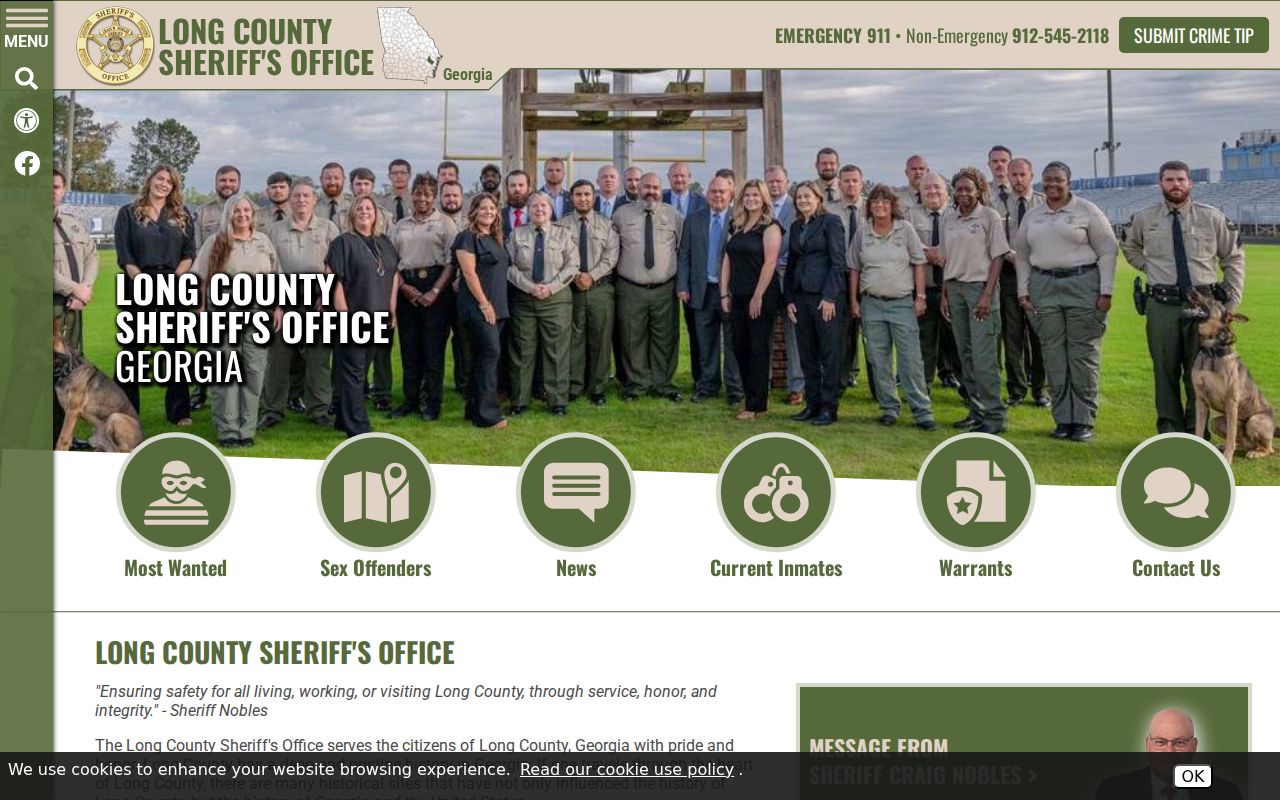
This official agency page lets readers tell the Long County sheriff's public contact channel apart from third-party warrant listings.
Long County Has No County Jail
Long County does not operate an active jail. The sheriff's jail and bonding page states that people booked by LCSO are housed in surrounding county facilities, including the Tattnall, Wayne, Appling, McIntosh, and Screven County jails. Call LCSO first to learn which facility is involved, because the place of confinement may differ from the agency holding the warrant. Bond is set by the proper judicial body, not the sheriff, and published options include cash, property, and approved bail bonds. Conditions vary. LCSO processes its holds even when another county runs the physical jail, so that jail may not be able to explain or lift the hold.
Note: Confirm the facility, hold agency, bond terms, and court date with Long County officials before sending funds or traveling.
If You Have a Warrant in Long County
A confirmed Long County warrant needs action, not worry. The sheriff advises anyone who knows of a warrant to turn themselves in at LCSO. Call ahead first. Staff can sort out timing, identification, transport, and bond before you arrive. That call matters here, because Long County runs no jail of its own and an unplanned visit can end in a transfer to another facility. Talk with a Georgia lawyer before you surrender, if you can. Counsel can pin down the issuing court, weigh a motion to recall or quash, handle bond, and set up an appearance. A recall withdraws the warrant. A quash sets the process aside. Neither a payment vendor nor any public page can promise you either result.
Important: Confirm the issuing court, seek legal advice, and arrange surrender or court action through official Long County channels.
Get proof once you pay, appear, or obtain the order. Then verify both the Long County court and sheriff records, since a traffic failure to appear may also require a separate DDS release check.
Long County Warrant Status Terms
Status words mark stages in a Long County warrant file. Use the exact word the current custodian supplies and record its date, because an old docket cannot safely be translated into "active."
- Issued
- A court authorized the process, without proving its present database state.
- Active or outstanding
- The responsible agency confirms it remains executable.
- Served or executed
- Law enforcement completed service or custody.
- Returned or not found
- An attempt failed; this is not a recall.
- Recalled, released, or quashed
- An authorized court or agency withdrew or cleared the process.
- Unknown
- No current official confirmation is public.
For conflicting answers, ask each office which dated record supports its response.
Long County Warrant Records and Public Access
The Georgia Open Records Act opens many agency files to the public, but it never forces Long County to build a fresh warrant report. Keep the request narrow. Ask for existing disclosable issue, service, return, recall, or release records tied to a date range and a known identifier. The sheriff publishes an Open Records procedure and lists records@longcountyso.org. Under that procedure a response is made within three business days when practicable. Search, retrieval, redaction, and production fees may apply, though the first fifteen minutes are free. One caution: the separate $20 criminal-history service is not a warrant-search fee.
Georgia access rules: O.C.G.A. § 50-18-70 defines public records and the no-new-report limit. Sections 50-18-71 and 50-18-72 govern response, cost, exemptions, and law-enforcement limits.
Expect withholdings in Long County warrant files. Pending investigations, juvenile material, medical details, protected people, and investigative methods may be redacted, so ask for the legal basis.
Requesting Long County Warrant Documents
A written request shows exactly what you sought, so put it in writing and address it to the likely custodian. For LCSO records, name the record type, the date range, the incident or case identifier, and your preferred electronic format. Ask for records showing the issuing court, issue date, service or return, recall or release, and status if an existing field contains it. Skip the demand for a new "all warrants" report; Georgia law does not require a new compilation. If another office holds the court record, ask LCSO to identify that custodian. A parallel inquiry can go to the Clerk of State and Superior Court at 912-545-2123 or the appropriate local clerk, which keeps your Long County warrant request moving on two tracks at once.
- Track the submission date and custodian.
- Keep the exact description and date range.
- Save estimates and expected dates.
- Record exemptions and redactions.
- Note any agency referral.
Avoid sending unrelated sensitive data by ordinary email.
Long County Most Wanted Limits
The Most Wanted page and the full set of Long County warrants are not the same thing. The sheriff picks what to post, while its internal database and GCIC/NCIC links serve agency needs, and the office publishes no update schedule or total count. The official disclaimer warns that public addresses may be wrong due to reporting or record errors. Never approach someone based on a posting.
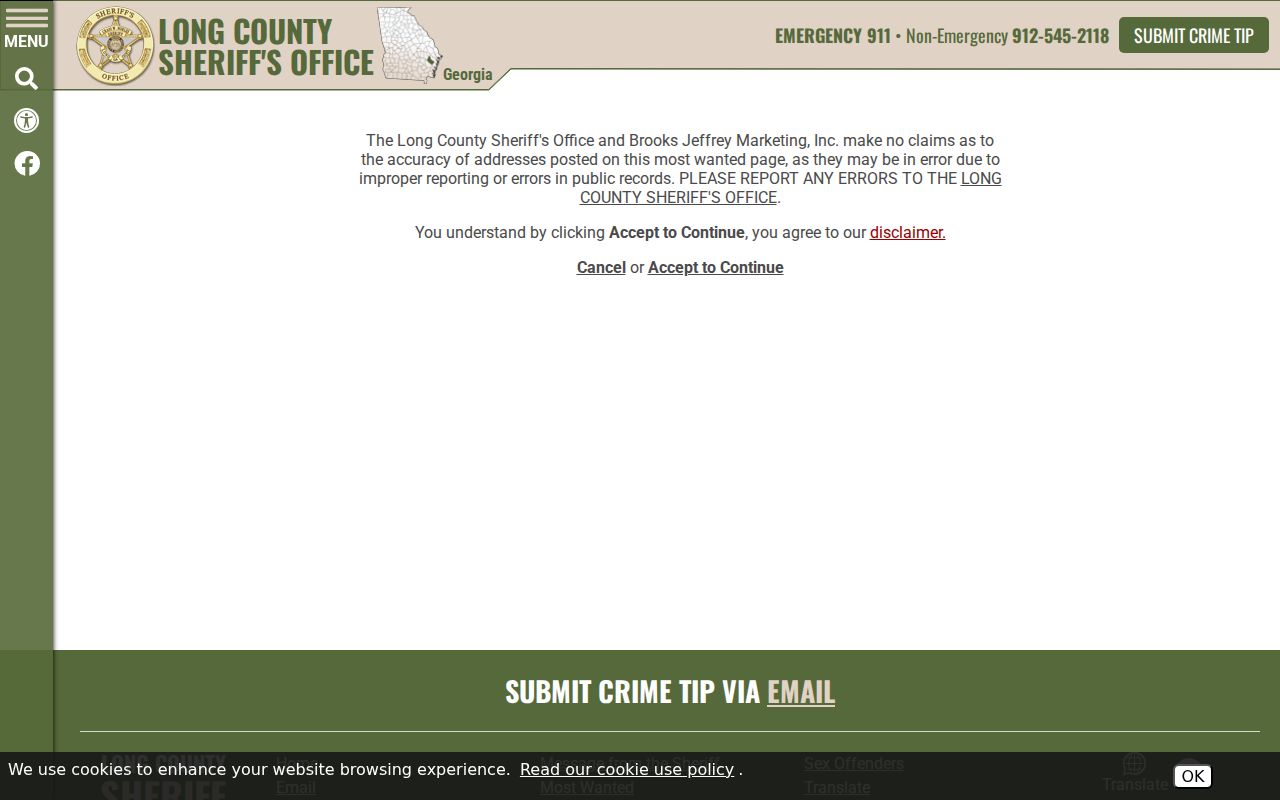
The warning supports direct verification and reporting errors to LCSO.
Georgia Systems Behind Long County Warrants
The Georgia Crime Information Center gives authorized agencies wanted-person and NCIC access, but it is not a public Long County warrant form. Georgia's public guidance sends people to their local sheriff. "Statewide system" means an agency network, not a public name search. Traffic cases add another layer, because Georgia has no centralized citation database. After a missed date, call the issuing court. DDS may show a separate license suspension, yet it cannot recall a Long County capias. Federal warrants sit in a different world entirely: they belong to the federal court and the U.S. Marshals system, not to any county docket. For a federal matter, Long County falls within the Southern District of Georgia. PACER is the official federal case-locator route, and the U.S. Marshals Service works through its federal district structure and Southeast Regional Fugitive Task Force. A federal docket or Marshals inquiry is separate from LCSO warrant records. CourtListener and RECAP may provide supplemental archived federal documents, but they are not government sources and should not be treated as current federal warrant confirmation. Child-support contempt, probate orders, and juvenile proceedings follow court-specific paths too, and they may involve custody consequences without ever appearing on the sheriff's curated Most Wanted page. Juvenile information carries added confidentiality limits, so direct those questions to the court clerk instead of applying the adult roster model. Civil process is one more look-alike: LCSO serves civil papers and records returns of service, but a civil paper is not automatically a criminal arrest warrant.
| Question | Starting Point |
|---|---|
| Current county warrant status | Long County Sheriff’s Office |
| Court order or recall | Issuing Long County court |
| Traffic FTA | State or Ludowici Municipal Court, then DDS |
| Federal case | Federal clerk, PACER, or U.S. Marshals |
Long County Warrants by City
Ludowici is Long County's only incorporated city. That makes the city picture simple. A city ticket or citation belongs to Ludowici Municipal Court, which handles municipal matters inside the city limits. Anything at the county level, including felony cases, runs instead through the sheriff, Magistrate Court, State Court, or Superior Court.
Ludowici
Ludowici Police Department and Municipal Court handle city police, ordinance, and traffic matters.
After a missed municipal court date in Long County, call the city court. The payment portal is not a warrant lookup, and paying alone does not prove the warrant was recalled.