
Long County Traffic Warrants Explained
A traffic citation starts a court matter. Missing its listed court date or failing to respond may lead to a failure-to-appear process, a court warrant or capias, and notice to Georgia DDS. These results are related, but they are not automatic or interchangeable. The issuing judge and clerk determine what occurred. Long County State Court handles misdemeanors, including traffic cases, while Ludowici Municipal Court is the city route for its traffic citations and local ordinance matters.
The court named on the citation is therefore the first useful fact. State Court lists 912-545-2123 and P.O. Box 458, Ludowici, GA 31316. Ludowici's city payment page lists 912-545-2732. Neither route is a public, live warrant database, and an old notice should not replace current clerk confirmation.
A traffic warrant is a court record and an instruction to law enforcement. It is not a driving-history report. The Long County Sheriff's criminal-history service and the Georgia Courts e-access provider answer different questions, so neither should be described as a traffic-warrant lookup. A docket may help identify the case, yet only the issuing court or LCSO can confirm whether court process remains executable.
No Central Long County Traffic Warrant Search
Georgia Courts explains that there is no centralized traffic-citation database. A new citation may take 7 to 21 business days to appear through a court vendor. That period can matter before the due date, but it is not a reason to wait after a court date has passed. Call the issuing court directly.
A vendor result is a citation or payment lead. It may not show a capias, judicial recall, agency hold, or the latest court direction. If no result appears, check the court name and citation details, then use the clerk's phone route.
The absence of a result can mean a recent citation has not reached the vendor, the wrong court was selected, the identifying data does not match, or the vendor does not expose that type of record. It is not proof that no Long County traffic warrant exists. Georgia's public warrant guidance routes a status question to the local sheriff, while missed traffic-date guidance routes the case question to the court. Those routes complement each other.
Checking for a Traffic Warrant
Gather the full legal name, date of birth, citation or case number, issuing agency, court name, and missed date. These identifiers help a clerk locate an existing Long County traffic warrant record, but they do not guarantee disclosure or a match. Use each available channel:
- Read the citation and identify Long County State Court or Ludowici Municipal Court.
- For a Ludowici ticket, use GovernmentWindow only as the city's citation and payment route.
- Call State Court at 912-545-2123 or City Hall at 912-545-2732 and ask whether an FTA, warrant, or capias exists.
- If told to visit, confirm the address and hours first. An in-person inquiry can lead to custody, so consider legal advice.
The Long County Sheriff's Office at 912-545-2118 is another status and surrender route if the court says a warrant reached the sheriff. A request to records@longcountyso.org may seek existing, disclosable records, but it is not instant status confirmation.
For a written record, identify the citation, issuing court, date range, and document wanted, such as an issued warrant, return, or recall order. Under the Georgia Open Records Act, an agency can provide existing, disclosable records but need not create a new status report. LCSO states that it responds within three business days when practicable, may estimate search or redaction costs, and may withhold protected material with a written legal explanation.
Ludowici Traffic Portal Limits
The official Ludowici payment landing page offers a Traffic Tickets choice beside other city payments. Research could not inspect the ticket fields because the next screen required robot verification. The tool can be described as city-linked payment access, not as a verified Long County traffic warrant search.
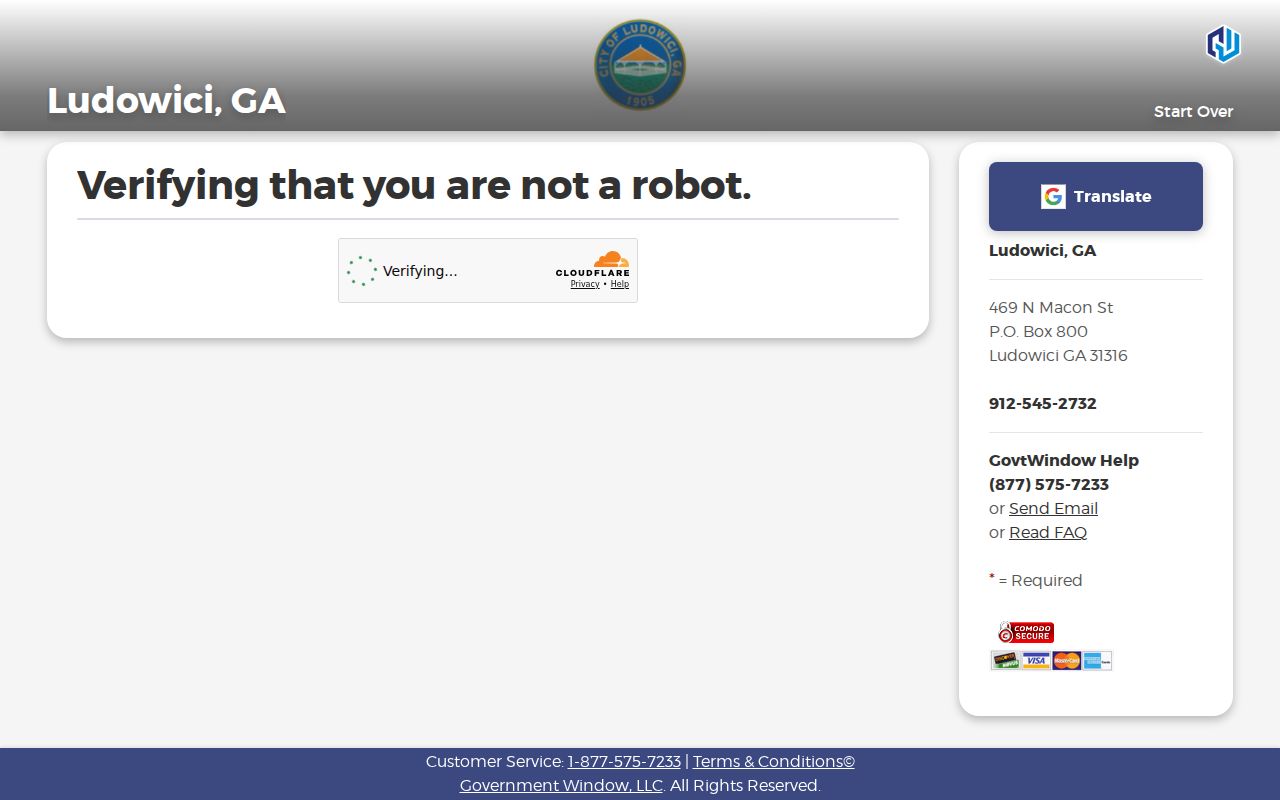
The empty verification state explains why a caller should keep the citation handy and contact the court rather than infer there is no record. A successful payment also does not prove recall without the clerk's confirmation.
Inside a Traffic Warrant Record
Long County does not publish a person-free sample traffic warrant or a verified public field schema. Ask the clerk to confirm these core fields on the existing court record, and do not invent a local number pattern.
| Warrant / Citation Number | Use the identifier exactly as printed, shown here as citation number as issued. |
|---|---|
| Charge / Offense | The traffic allegation on the citation or docket, not a finding of guilt. |
| Issuing Court | Long County State Court or Ludowici Municipal Court. |
| Bond / Fine Amount | The amount the court confirms; the sheriff does not set bond. |
| Status | Ask about FTA, warrant or capias, payment, release, recall, and effective dates. |
Long County Traffic Warrant Court Route
State Court's official page says it handles misdemeanor traffic cases and authorized warrant hearings. It lists court on the second and fourth Wednesday at 9 a.m. unless otherwise notified, while reminding each person to contact the clerk. A mailed notice and current Long County traffic warrant status are separate questions.
The court-linked nCourt page displays court address and payment contacts.
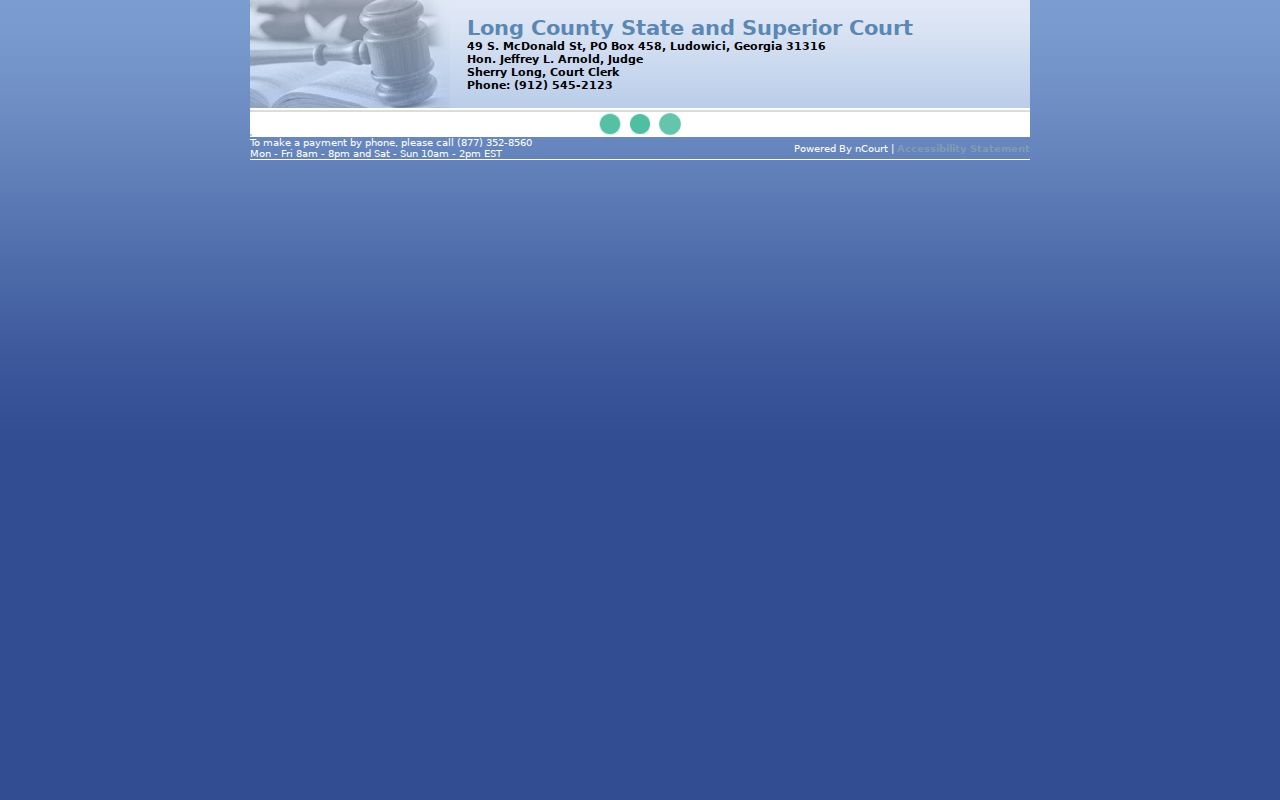
The panel helps route a payment, while the clerk remains the source for warrant status, a required appearance, or a judicial recall.
State Court and Municipal Court should not be merged into one account. A citation from a county deputy may follow the State Court route, while a Ludowici city citation may follow the municipal route. Ask the clerk to read back the case number and court name before paying. This simple check reduces the chance of sending money through the wrong channel while the actual Long County traffic warrant remains unresolved.
How to Pay or Lift a Traffic Warrant
First confirm the issuing court and current status. A clerk may direct payment, a new appearance, bond, or another step. No single option applies to every Long County traffic warrant. A vendor processes an eligible payment; only the court can say whether related court process is recalled or released.
- Ask the clerk to confirm the citation, FTA or capias status, amount, appearance, and accepted method.
- Follow the court's direction to pay, appear, or address bond. Keep the receipt and case number.
- Ask when the court will document recall or release and transmit any required DDS release.
- Recheck with the court, then verify the separate DDS record through DDS Online Services.
Warning: A receipt alone does not confirm recall. Obtain the court's status and verify any separate DDS release before treating the matter as closed.
After a Missed Long County Traffic Warrant Date
Call the court printed on the ticket and ask four distinct questions: whether it recorded an FTA, whether a warrant or capias issued, what action is required, and whether DDS received notice. This keeps the court case separate from the state consequence. Do not wait for an online record after the date has passed.
Track three dates: Keep the citation date, scheduled court date, and any DDS notice or effective date with each confirmation and receipt.
If State Court directs the matter to LCSO, call before visiting. If Ludowici Municipal Court is named, use City Hall for current clerk routing. There is no verified Long-specific amnesty or walk-in clearing event.
Long County also does not operate its own jail. If an inquiry leads to arrest, LCSO may use one of several surrounding county facilities and processes its own holds. Ask LCSO which facility is involved, which court set bond, and which office can explain the hold. A neighboring detention facility cannot necessarily recall a Long County warrant merely because it houses the person.
Traffic Warrants, FTA, and License Holds
One missed traffic date may lead to more than one record. FTA describes failure to appear or respond. A warrant or capias is court-directed process. A DDS suspension is a separate state consequence based on court notice. Resolving one does not prove the other records have updated.
| Mechanism | What Triggers It | What It Does |
|---|---|---|
| Traffic warrant or capias | A judge acts after an unresolved citation or missed setting. | Creates court-directed custody process until authorized action. |
| Failure to appear | The person misses or does not respond to a court setting. | Records the missed response and may start court and DDS steps. |
| DDS suspension | DDS receives court notice of the traffic FTA. | Affects the license record and requires separate release verification. |
DDS Release After a Long County Traffic Warrant
Georgia DDS says an FTA suspension becomes effective 28 calendar days after it receives notice. Resolve the citation with the court, confirm that the court submits the release, and then check DDS Online Services. Most courts send releases electronically, but that does not remove the need to verify.
The DDS FTA page shows the timing and release route.
This state step follows the Long County court step and does not replace the issuing clerk's warrant confirmation.
The DDS fee page displays $90 by mail or in person and $100 online for FTA reinstatement, subject to the individual record.
This is a DDS fee, not a Long County fine or sheriff bond. Confirm the amount shown for the individual DDS record.